What is Improvers Pilates? Is It Right For Me?
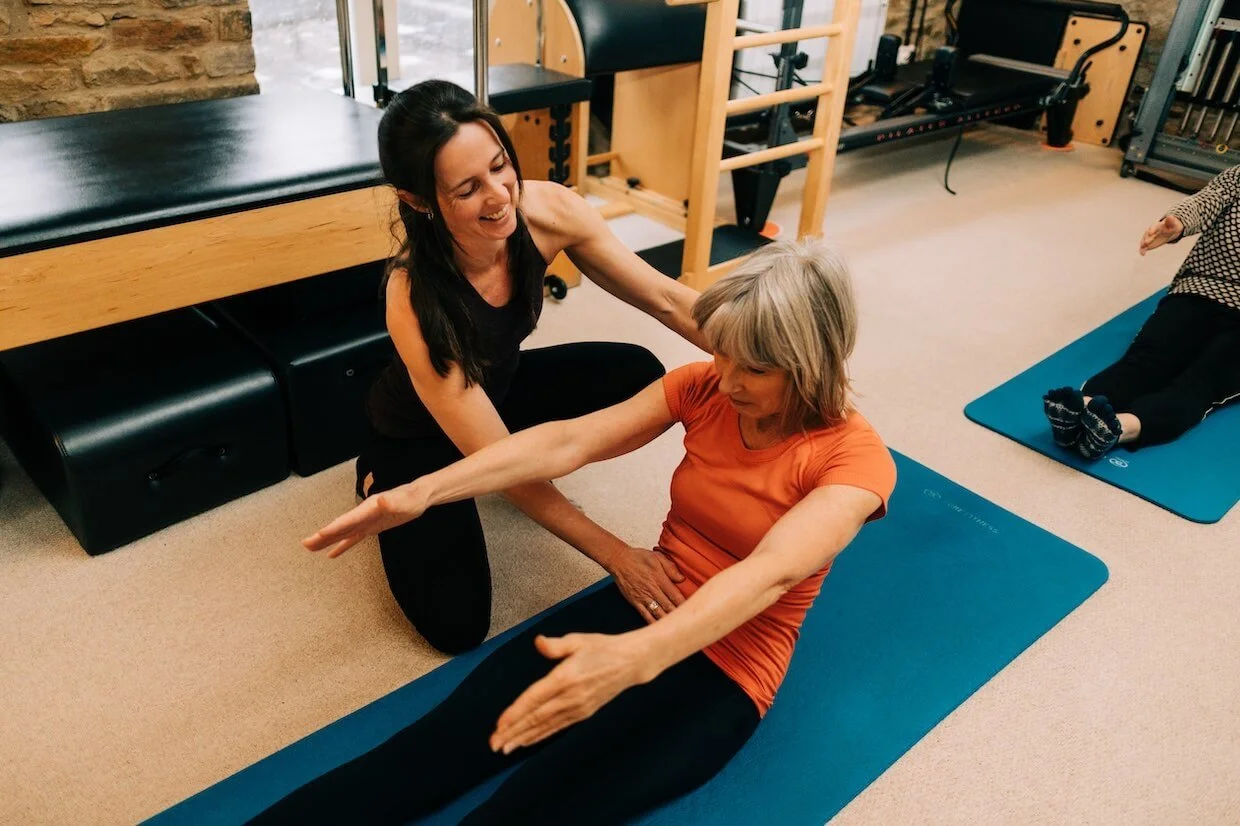
Improvers Pilates is the perfect stepping stone for those who've mastered the basics but aren't quite ready for full Intermediate complexity.
It's where you refine technique, build confidence, and prepare for more advanced challenges at your own pace. This bridge level gives you time to consolidate your learning, deepen your understanding of the eight principles, and develop the strength and body awareness that makes intermediate work both safe and enjoyable.
Progress at Your Pace with Rachel Luxon Pilates
While this article describes the "improvers" stage of progression, Rachel's classes aren't strictly divided by level. Exercises within each session are tailored to suit your current ability and progression needs.
Book a one-to-one assessment first. Rachel will evaluate where you are now and recommend classes that will challenge you appropriately as you develop.
There's a frustrating gap in many Pilates studios between beginner classes and intermediate work. One feels too easy now; the other feels overwhelming. You understand the basic principles and can perform fundamental exercises, but complex sequences with minimal instruction leave you lost. Perhaps you've been practicing for a few months and are ready for more challenge, or you've done Pilates elsewhere and want to refresh your technique before advancing.
This is exactly why Improvers Pilates exists. It's not about rushing your progression or holding you back—it's about meeting you in that in-between space where you're building from foundations toward genuine skill. You're learning to write sentences after mastering the alphabet, developing fluency before attempting poetry.
Let's explore what makes Improvers level unique and why taking your time here creates better, safer, more sustainable progression.
Explore our class schedule to find classes that fit your timetable.
What is Improvers Pilates?
Improvers Pilates bridges the gap between Beginners and Intermediate levels, offering structured progression for those who've internalised basic principles but need more practice before tackling complex work. Think of it as consolidation rather than simply advancement—you're deepening understanding, refining technique, and building the neuromuscular patterns that make challenging exercises accessible.
At this level, you'll encounter greater variety of exercises and movement patterns to keep your practice engaging while challenging your body in new ways. The fundamental exercises you learned as a beginner return with progressive variations—more repetitions, longer holds, greater ranges of motion, or added complexity. You'll begin linking movements into short sequences, developing the flow and coordination that characterises more advanced practice.
The pace sits comfortably between beginner and intermediate. Where beginners receive extensive explanation for every detail and intermediates move quickly through sequences, improvers get clear instruction with time to practice and refine. You're expected to remember basic principles and fundamental positions, but new exercises are still taught thoroughly. The goal isn't to memorise every exercise but to understand the patterns and principles that make Pilates effective.
Improvers classes incorporate more props—resistance bands, Pilates balls, foam rollers, and sometimes light weights for bone health work. These tools add variety and challenge while providing feedback about your alignment and engagement. The work becomes more three-dimensional, challenging your balance, coordination, and ability to stabilise while moving.
What makes improvers level special is the permission it gives you to progress at a sustainable pace. There's no rush to move up and depending on your body, your history and needs, some clients will find that this is the best class for them to stay in. Others might change class after three months at this level; whilst some will stay for a year or more.
All are perfectly appropriate depending on your attendance frequency, body awareness, medical history and personal goals. The Body Control Pilates method we use emphasises quality progression over speed, ensuring you build genuine competence rather than just mimicking shapes.
Who is Improvers Pilates For?
Improvers level serves several distinct groups, all united by the need for that stepping-stone between basic and advanced work.
Beginners graduates who've completed 8-12 weeks of consistent beginner practice form the core improvers population. You understand the eight Pilates principles, can maintain core engagement during simple exercises, and feel comfortable with fundamental movements. You're ready for more challenge but recognise you're not yet ready for the pace and complexity of intermediate classes.
Those wanting to deepen foundations before advancing appreciate the extra time at improvers level. Perhaps you could handle intermediate exercises physically, but you value the technical refinement that comes from practicing progressions with attention to detail. Building excellent technique now serves your practice for years to come.
People returning to Pilates after a break often find improvers level perfect for rebuilding. You remember the basics but need to re-establish strength, flexibility, and body awareness. Starting at improvers rather than beginners gives you appropriate challenge while allowing time to regain previous competence.
Those with physical limitations requiring modifications benefit from the improvers environment where exercises are still adapted for different bodies but the challenge level is higher than beginners. Your instructor will modify exercises for your specific needs while maintaining the class's progressive nature.
Anyone wanting to take Pilates seriously and build proper technique rather than just attending casually finds value in the improvers focus on precision and quality. This is where you develop from someone who "does Pilates" to someone who practices Pilates with understanding and intention.
The age range and fitness levels in improvers classes vary widely, just as in beginners. What unites everyone is the willingness to work on refinement rather than rushing to the next level. You'll find former athletes alongside people who've never been particularly active, all working on their edges together.
What Makes Improvers Different from Beginner Classes?
Understanding what shifts between beginners and improvers helps you recognise whether you're ready for this class and what to expect when you arrive.
The variety expands significantly. Where beginners might practice eight to ten core exercises each week with extensive repetition for motor learning, improvers encounter a broader range of movements. You'll recognise familiar exercises but meet them in new contexts—combined with other movements, performed with props, or challenged through greater range of motion.
The challenge increases through more repetitions, longer holds, and progressive variations. If beginners perform five pelvic curls, improvers might do ten, then add a single-leg variation. The Hundred you learned in beginners becomes longer, with legs extended rather than bent. These progressions build genuine strength and endurance.
Exercise combinations begin to appear, linking movements into short sequences that develop flow and coordination. Rather than stopping after each exercise to reset, you'll transition from one movement to the next, maintaining engagement throughout. This creates the continuous challenge that makes Pilates such effective conditioning.
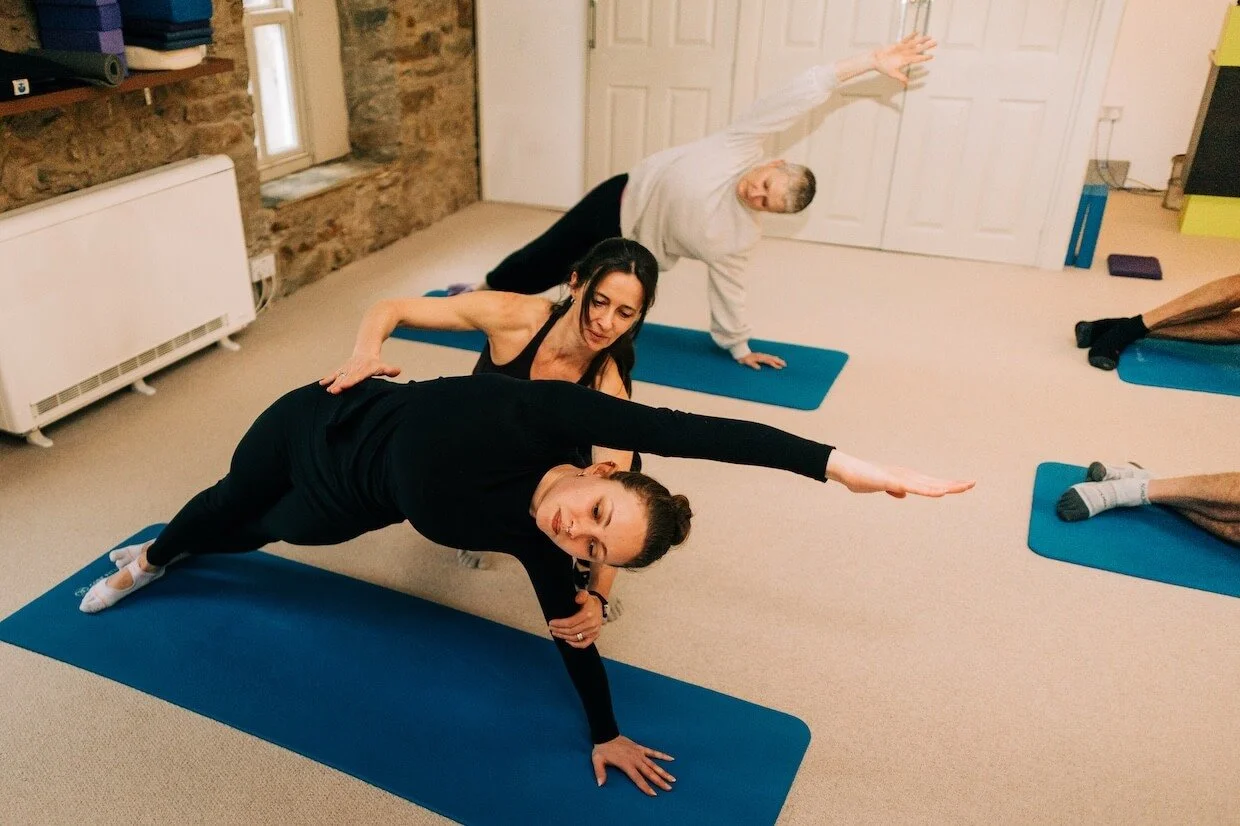
Balance and coordination work intensifies with more exercises from the classical mat repertoire (such as single leg stretch), less stable positions, and movements that challenge your proprioception. These exercises build the body awareness and control essential for more advanced work while reducing fall risk in daily life—particularly valuable as we age.
The mental challenge grows alongside physical demands. You'll need to remember more, coordinate breath with increasingly complex movements, and maintain focus throughout longer sequences. Many students find this cognitive engagement as valuable as the physical work, creating a moving meditation that demands complete presence.
However, you still receive clear instruction and demonstration for new exercises, hands-on corrections when needed, and individual modifications for your body. The class size remains small, the atmosphere stays supportive and non-competitive, and the pace allows for learning rather than just performing.
Curious about where Improvers fits in your progression? Explore our class schedule to see all levels we offer, or learn more about the Body Control Pilates method that ensures safe, effective progression at every stage.
The Benefits of Improvers Training
While every Pilates level offers benefits, the improvers stage creates specific advantages that rushing past it would mean missing.
Technical excellence develops when you take time at improvers level. The additional practice with progressive variations builds movement patterns that become automatic. You're not just learning exercises; you're training your nervous system to stabilise, move, and breathe correctly without conscious thought. This technical foundation serves you for life, making everything else safer and more effective.
Real strength gains become noticeable at this level. The increased repetitions, longer holds, and added resistance create genuine conditioning. Core strength improves measurably. Hip and glute muscles that were dormant begin firing properly. Shoulders stabilise. The functional strength you build translates to carrying shopping, lifting children, gardening, and every other physical demand of daily life.
Improved functional movement shows up in better balance, enhanced coordination, and body awareness that prevents injury. You begin moving more efficiently throughout your day—bending, reaching, twisting, and carrying with better mechanics. Many improvers students notice reduced clumsiness and fewer minor tweaks and strains.
Cognitive benefits emerge from learning new movements and sequences. The mental challenge keeps your brain sharp and engaged, building neural pathways while you build physical strength. This cognitive stimulation is increasingly recognised as valuable for brain health across the lifespan.
Injury prevention results from proper progression. Taking adequate time at improvers level means you arrive at intermediate work with the strength, control, and body awareness to perform complex exercises safely. Rushing this stage often leads to compensatory patterns and strain.
Confidence building might be the most transformative benefit. Mastering improvers exercises creates genuine confidence in your Pilates practice and your body's capabilities. This confidence extends beyond the studio, influencing how you approach physical challenges everywhere.
The clear progression you experience—seeing measurable improvement week to week—provides incredible motivation to maintain consistent practice. Unlike some fitness approaches where progress plateaus quickly, Pilates continues offering achievable challenges as long as you practice.
Improvers in the Pilates Progression Path
Understanding where improvers sits in relation to other levels helps you appreciate its value and know when you're ready to move on.
If Beginners Pilates teaches you the alphabet of movement—individual letters, basic sounds, fundamental building blocks—improvers is where you build words and simple sentences. You're combining elements, creating meaning, developing fluency. Intermediate Pilates then asks you to write paragraphs and complex passages, assuming fluency and focusing on refinement and style.
The comparison illuminates why rushing from beginners to intermediate often creates problems. Jumping from alphabet to poetry without learning sentence structure leaves you lost and frustrated. You might mimic the shapes, but you miss the understanding that makes them effective and safe.
The pace at improvers sits comfortably in the middle—faster than beginners' detailed explanations, slower than intermediate's flowing sequences. You get enough instruction to understand new challenges without excessive hand-holding that prevents learning.
Exercise selection progresses from fundamental basics through variations and combinations toward the complex sequences you'll encounter at intermediate. Each level builds on the previous, creating scaffolded learning that develops competence sustainably.
The challenge level increases systematically. Where beginners work at gentle introduction intensity, improvers encounter moderate challenge that stimulates adaptation without overwhelming you. Intermediate then provides high challenge for those with solid foundations.
Modifications remain readily available at improvers level, though you'll need them less frequently than in beginners classes. Your instructor still adapts exercises for individual needs, but the expectation is that you're developing the strength and control to perform more variations as offered.
Many people combine levels thoughtfully, attending both improvers and intermediate classes, or mixing improvers mat work with specialised classes like HIP Pilates for targeted hip strengthening or even exploring Reformer Pilates for equipment-based challenges. There's no rule requiring you to attend only one level—intelligent practice often means variety.
Special Focus: Back Care in Improvers
Many improvers students come specifically for back health, seeking to build strength while managing back concerns. This makes improvers level ideal for combining progression with therapeutic attention.
The exercises at improvers level challenge your core and spine appropriately without the aggressive intensity that can aggravate back problems. You'll work on safe spinal movements—articulation, extension, rotation—that improve mobility while building the strength that supports your back. Core strengthening happens without the strain of excessive repetitions or poor form.
Posture correction receives particular attention at this level. You've learned what neutral alignment feels like in beginners classes; now you practice maintaining it through more challenging movements. This builds the postural endurance that prevents the slouching and slumping that contribute to back pain.
Functional movement patterns for daily activities—bending, lifting, reaching, twisting—are practiced with Pilates principles applied. Learning to move through daily tasks with proper alignment and core engagement prevents re-injury and reduces chronic pain.
If you're building strength while managing back concerns, let your instructor know. Exercises can be modified to work within your current capacity while still providing appropriate challenge. The goal is always to build capability progressively, not to push through pain or create new problems.
How Long Should You Stay at Improvers Level?
This is like asking “how long is a piece of string”? often because we're conditioned to see progression as always moving upward. But staying at improvers level as your regular class can be intelligent practice.
Most people spend at least three to six months at improvers level with regular (weekly) practice. If you attend multiple times per week and have good body awareness from other movement disciplines, you might progress to an intermediate class in a few months. If you attend less regularly, have injuries requiring extended modification, or simply want more time to refine technique, staying six to twelve months is perfectly appropriate.
….Quality foundation work at improvers level creates better intermediate practitioners than hurried advancement. The students who stay longer often develop more refined technique and deeper understanding than those who rush to do more advanced Pilates.
You're ready for intermediate when you can maintain core engagement through entire classes without losing connection, understand and apply all eight Pilates principles without constant cueing, demonstrate significantly improved body awareness, perform improvers exercises with good form consistently, attend classes regularly (weekly minimum), feel ready for less explanation and more challenge, and find balance and coordination exercises comfortable rather than overwhelming.
Your instructor will discuss readiness with you when the time seems right. Progression decisions are collaborative conversations, not judgments about your worth or capability. Some weeks you might feel ready; others you'll want more time. This variability is normal—listen to your body and trust the process.
Ready to Refine Your Practice?
Improvers Pilates offers the perfect environment for sustainable progression—challenging enough to stimulate growth, supportive enough to build confidence, structured enough to ensure safety. Whether you're a beginners graduate ready for more, someone returning to Pilates after time away, or a practitioner wanting to deepen technique before advancing, improvers level gives you exactly what you need.
The time you invest at this stage pays dividends throughout your Pilates journey. Technical foundations built now make everything else easier, safer, and more effective. The strength and body awareness you develop serve you in every physical activity and daily task. Most importantly, you build genuine competence rather than just surface-level ability to copy movements.
Our improvers classes welcome students at various stages of this journey, creating a supportive community of people committed to quality practice. You'll work hard, learn continuously, and progress at the pace your body needs rather than arbitrary timelines demand.
Find Your Next Challenge
Explore our class schedule to see improvers sessions that fit your timetable. If you're currently in beginners classes, speak with your instructor about your readiness to progress. If you're new to our studio but have practiced Pilates elsewhere, get in touch to discuss which level suits your current practice.
Ready to bridge the gap between beginner and intermediate? Book your first Improvers class and discover the satisfaction of building your practice properly, with time to refine, strengthen, and prepare for whatever comes next in your Pilates journey.
Looking to complement your improvers practice? Discover HIP Pilates for targeted hip health work, Pilates for Life for age-appropriate movement, or explore our Beginners and Intermediate classes to understand your complete progression path.